
A clean composite deck takes one afternoon, a soft-bristle brush, and the discipline to keep pressure under 1,500 PSI if you reach for a power washer. Most people gouge the surface or let the cleaner dry into a stubborn film because they work in sections too large for the weather.
The part that actually costs you: clearing the deck properly. Lift every planter and chair instead of dragging, or the board beneath the scratch will hold grime differently for years. I learned that the first time I cleared a deck and left a gouge that stared back all summer.
1. Clear the Deck
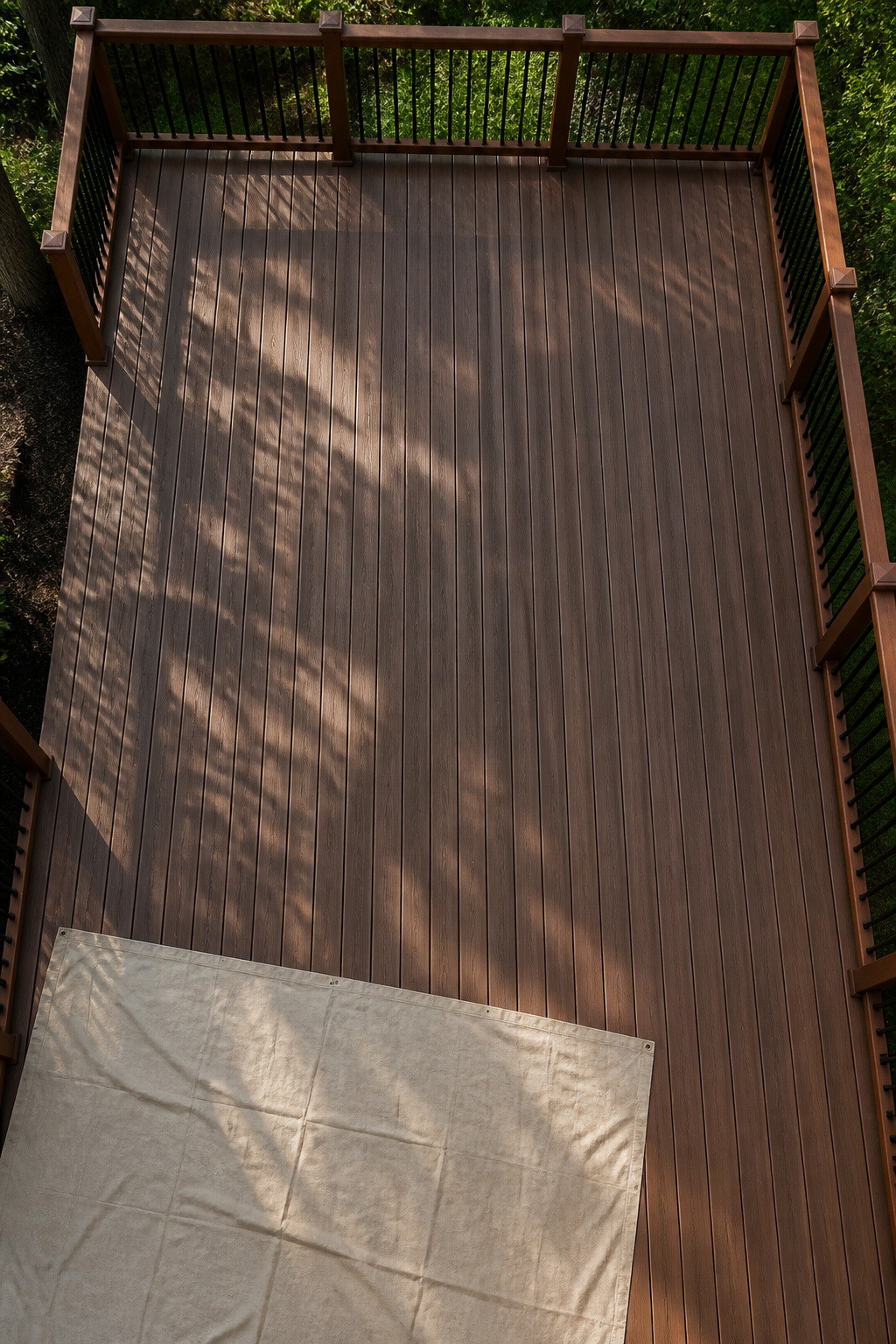
The first time I cleared a deck for cleaning, I dragged a planter across the boards and left a gouge that stared at me all summer. Now I lift and carry everything, even the heavy stuff, and the surface stays intact. Tables, chairs, potted plants, the grill, the stray toys that collect in corners, all of it comes off before a single drop of composite deck cleaner hits the surface.
Two ways to handle a large or crowded deck. One: clear it all at once and have the full run of the space. Two: shift everything to one side, clean and rinse that half, then move it all across and repeat. The second method costs you time but saves your back if the furniture is heavy or the stairs are awkward. Either way, check underneath the deck if the space below is used for storage or living, and clear or cover anything that could catch splatter. Nearby plants get the same treatment, lifted away or draped with a tarp, because overspray happens even when you’re careful.
2. Remove Debris
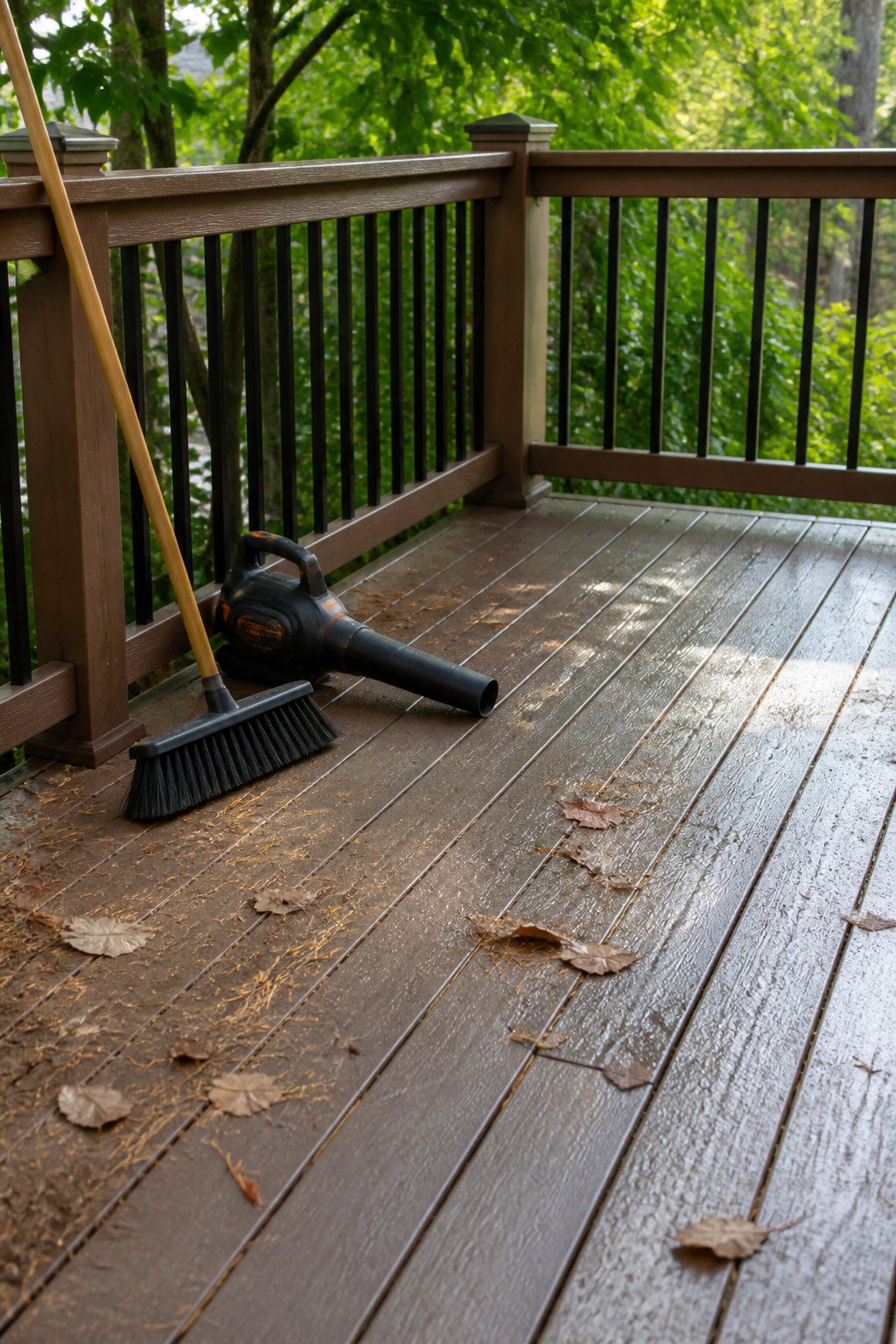
Leaves and pine needles left on composite decking do more than look messy. They trap moisture against the boards and give algae the damp, organic residue it needs to take hold, especially on north-facing decks or spots under trees. Sweeping before you clean is what keeps grit from scratching the surface when you move to scrubbing later.
A broom works fine for open areas, though a leaf blower saves time if the deck is large or packed with needles. Either way, check the gaps between boards and the corners where debris packs tight. That packed dirt blocks your composite deck cleaner from reaching the actual stain underneath.
This is also the moment to wet nearby plants and cover anything you cannot move. Dry leaves will blow away now; wet ones cling. Work on a day when the boards are cool and out of direct sun, so nothing bakes onto the surface while you are still clearing it.
3. Prepare the Cleaner
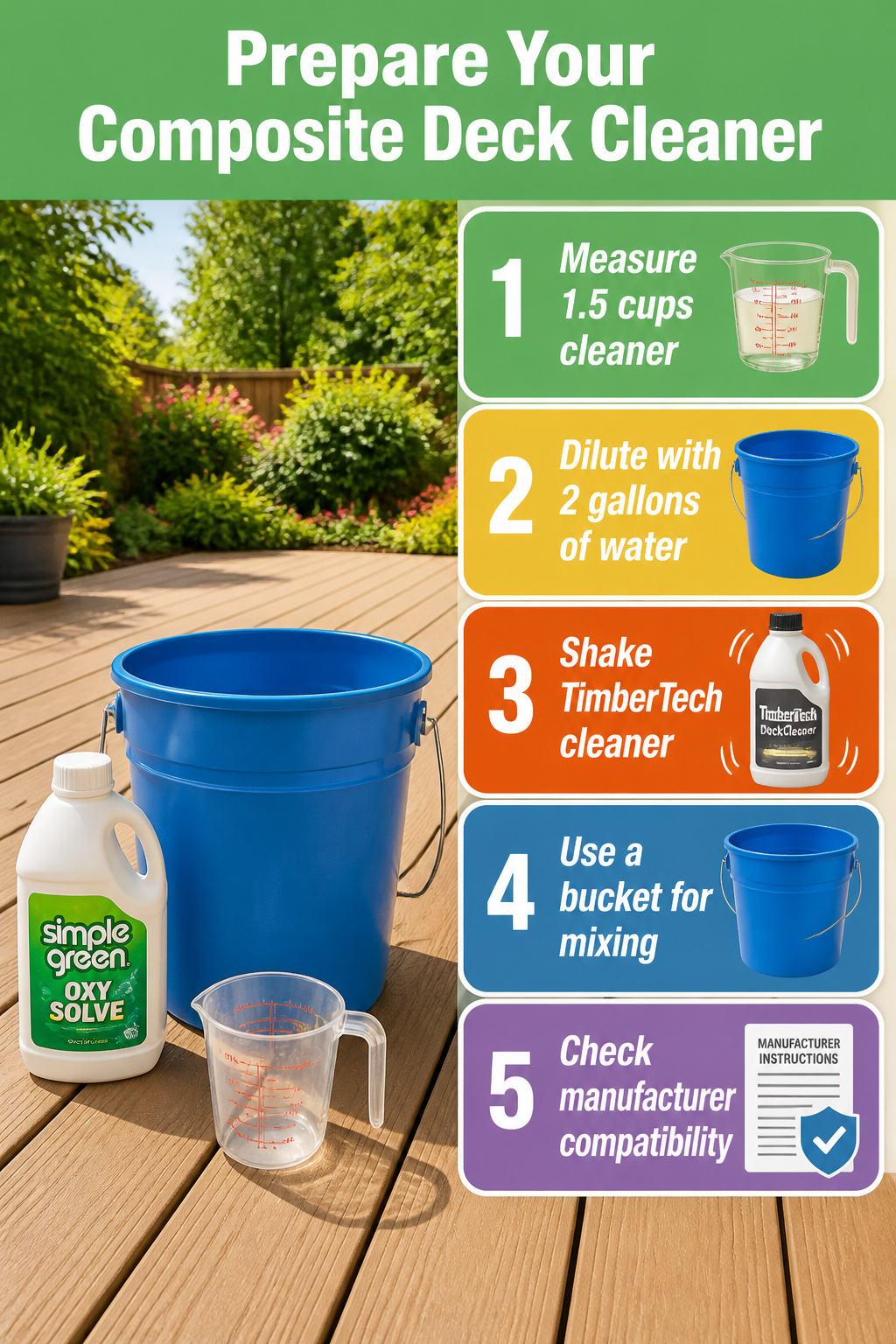
Simple Green Oxy Solve mixes at 1 part cleaner to 20 parts water for manual work. That ratio lands at 1.5 cups of cleaner per 2 gallons of water, which fills a standard bucket and covers a comfortable section before the solution starts to dry on the boards.
TimberTech DeckCleaner shakes up first, then dilutes per the label. One gallon of the mixed solution stretches across roughly 1,000 square feet, so a typical suburban deck drinks down a quarter to half of that.
Both paths need a bucket and a measuring cup. The Simple Green route demands more liquid upfront because the dilution is lighter. The TimberTech concentrate goes further per bottle, but only if the math on your square footage is honest. I have misjudged deck area by counting the house wall as one edge and forgotten the stairs entirely, then mixed too little and watched the last ten feet sit dirty while I ran back to shake another batch.
Other approved options exist: Wash Safe Spray and Clean, or plain Dawn dish soap in water. Before swapping in anything the deck builder did not name, check the manufacturer. Compatibility slips past easy, and the wrong surfactant can cloud the cap stock or strip the warranty language you never read until there is a problem.
4. Section Off the Deck
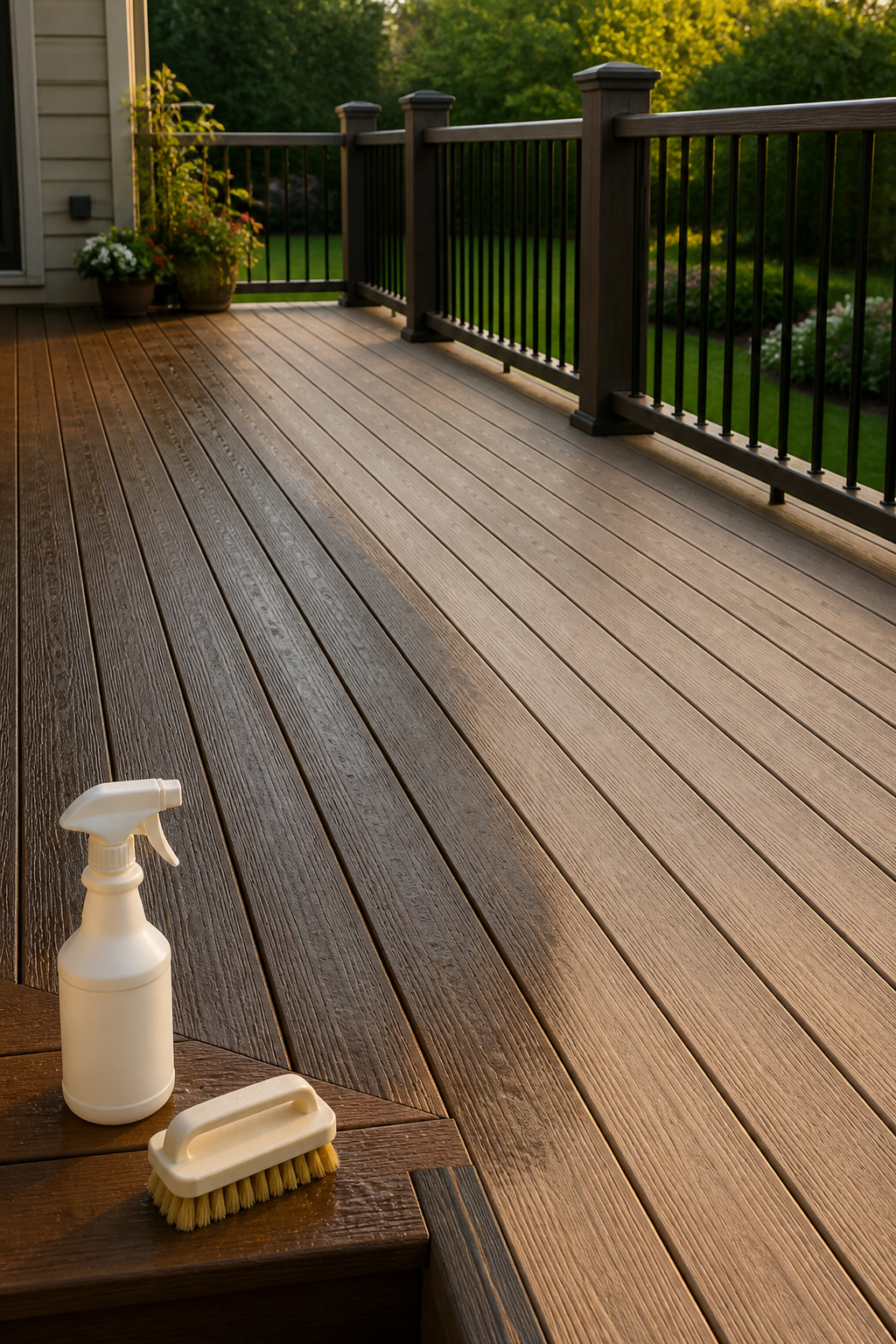
Composite deck cleaner works best when the boards stay wet long enough to do its job, which means the deck needs to be split into sections you can finish before the sun gets to them. On a warm afternoon I once let a treated area sit too long while I moved a hose; the cleaner dried into a faint film that took another round of re-wetting and scrubbing to lift. TimberTech recommends letting the solution stand for 30–60 seconds before agitation, which sounds brief until you factor in rinsing time. Work in small enough chunks that you can scrub and hose off before evaporation starts, and if the deck is in full sun, tackle it in the morning or evening when boards stay cooler. Simple Green’s instructions note that re-wetting is an option, but that extra step is time you could have spent on the next section instead of fixing the last one.
5. Clean and Rinse the Deck
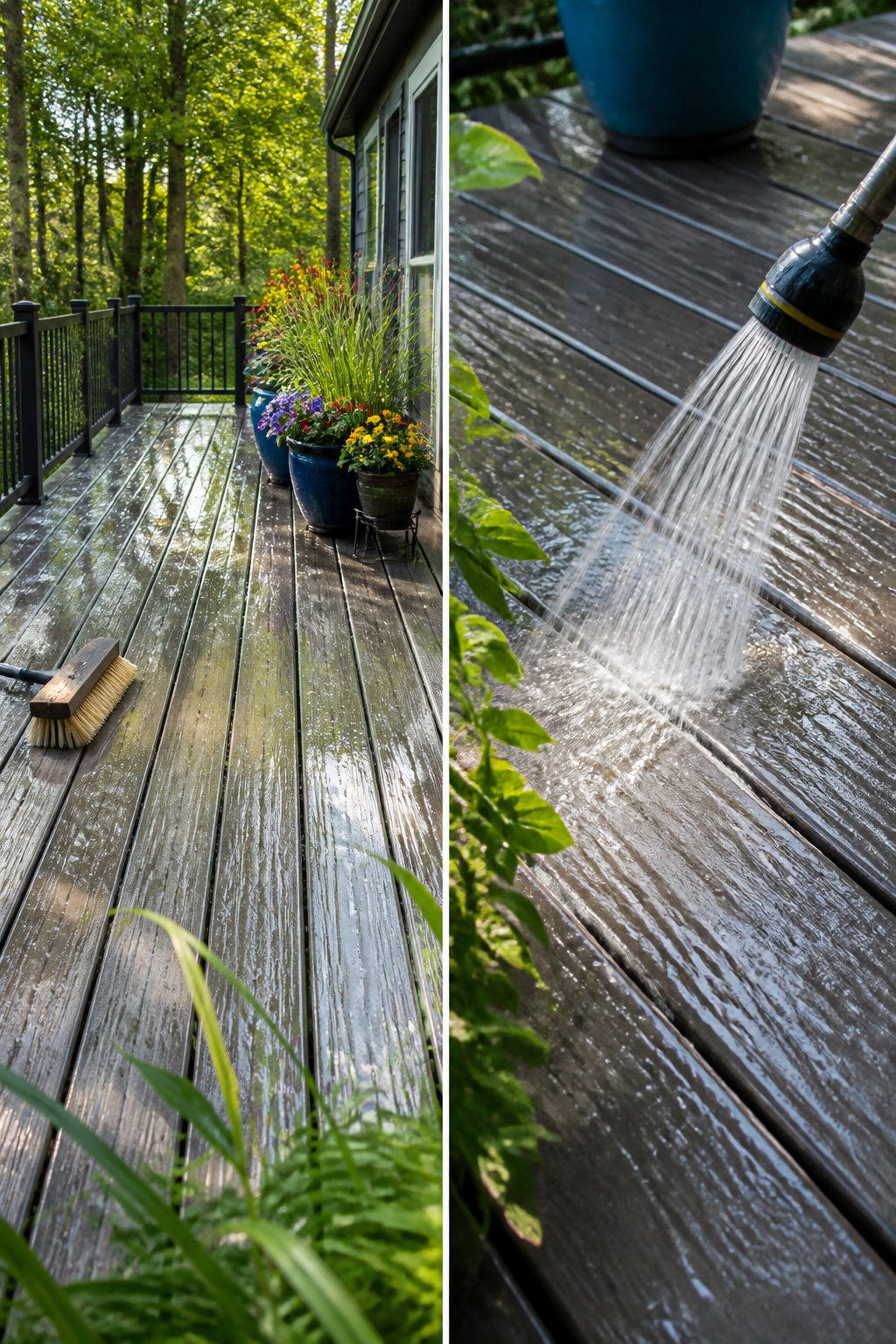
Soft-bristle brushes clean composite decking without scratching the surface, while wire or hard-bristle tools risk damaging the outer finish and creating spots where dirt and algae collect. The first time I scrubbed a deck, I worked in sections small enough to rinse before the cleaner dried, re-wetting as I went. A garden hose at high pressure handles the rinse; move methodically from one end to the other, including gaps between boards and areas around railings.
Pressure must stay below 1,500 PSI with a fan tip nozzle, and even then it is only for rinsing, not for doing the actual cleaning. Keep the wand off the deck surface while running it. High pressure scars boards, raises surface texture, creates striping, and forces water where it does not belong. A pressure washer never substitutes for the right cleaning solution and proper brush work.
Wet nearby landscaping before you start, and rinse any plants the cleaner touched afterward. Flush your equipment with water before storing it.
6. Dry the Deck
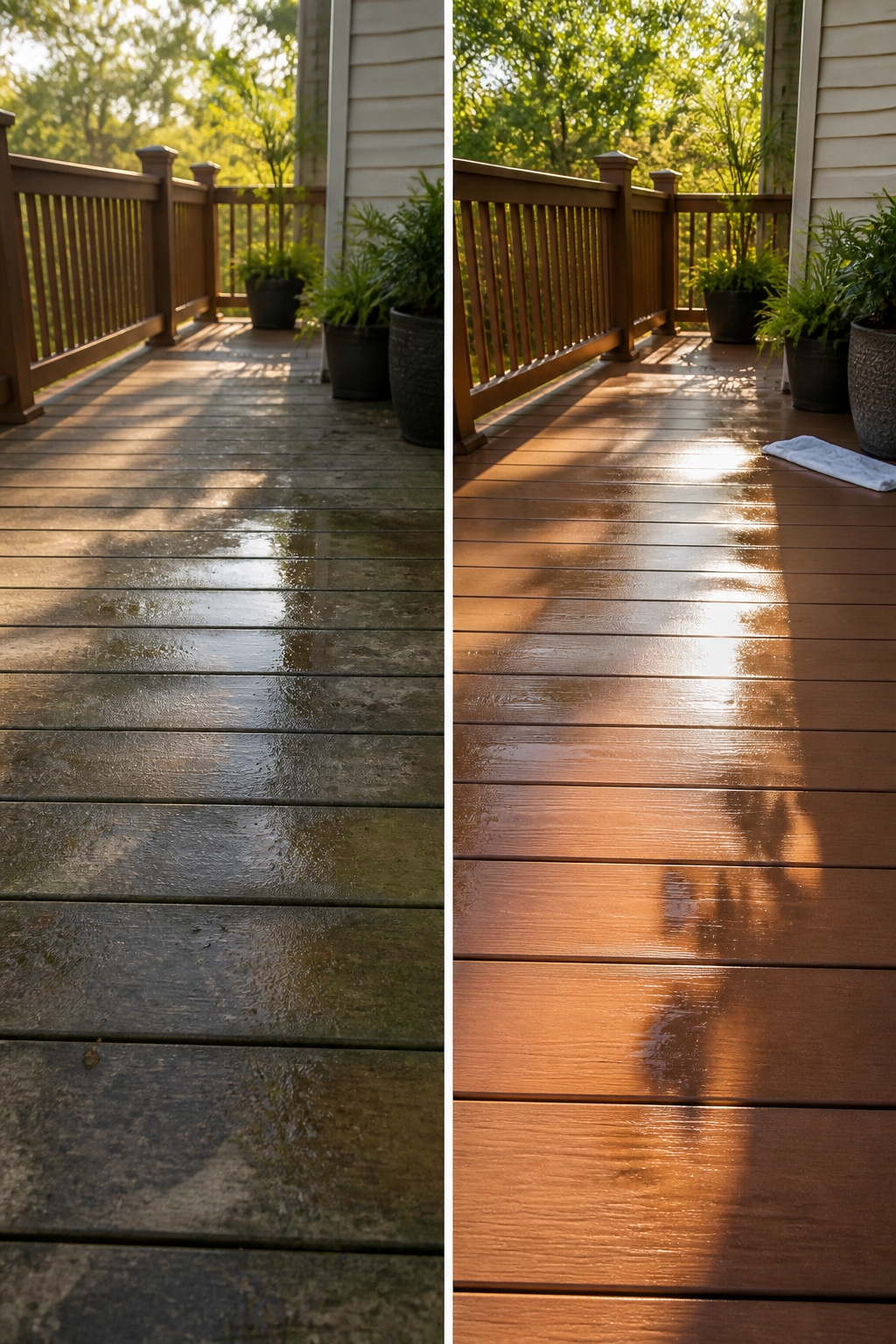
Standing water on composite decking hides streaks and missed patches the way a wet sidewalk hides salt stains. The gloss fools you. A cotton terry cloth, a sponge mop, or a leaf blower finishes the job, and the motion matters: follow the grain of the boards if you can. TimberTech suggests this direction specifically, and after rinsing, it is the difference between a surface that looks clean and one that actually is.
The dry surface tells the truth. Spots you walked past while scrubbing reappear. Streaks from cleaner that sat too long show as film. This is the moment to spot-treat again, not after the furniture is back and the afternoon is gone. I have skipped this step in other projects and regretted it; the white haze of dried cleaner does not forgive laziness.
Do not let cleaner dry on the deck. Rinse it off immediately after scrubbing. If it does set, you are scrubbing the same twelve feet twice, and nobody budgets an afternoon for that.
7. Recommended Cleaners Compared
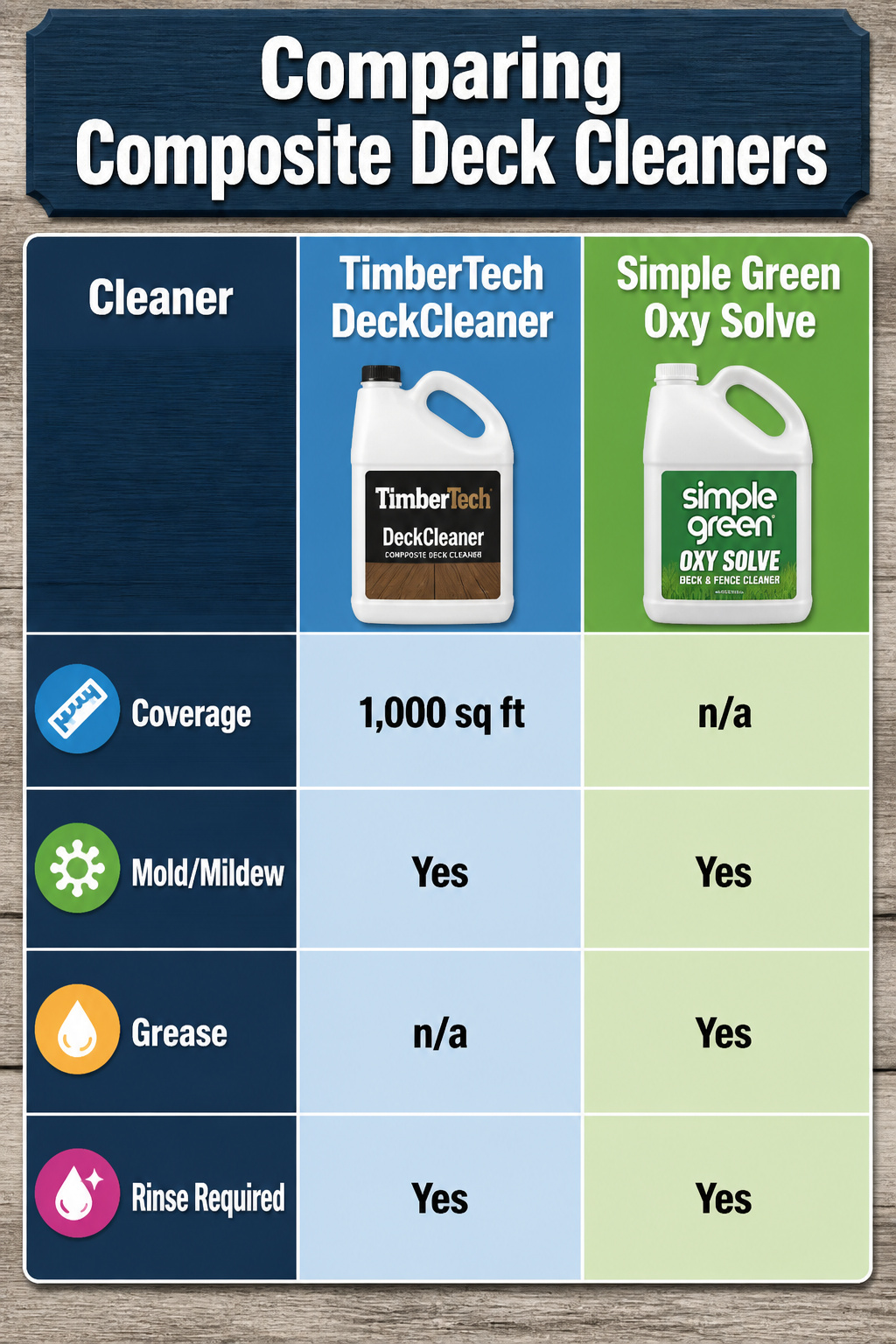
Five composite deck cleaners handle the same job with different trade-offs. TimberTech DeckCleaner covers 1,000 square feet and is formulated specifically for composite boards, so it is the safest starting point on newer capped decking where warranty protection matters. Simple Green Oxy Solve dilutes 1:20 and is marketed as eco-friendly, though it still needs manual scrubbing and a thorough rinse on plants and equipment after. Wet & Forget Xtreme Reach doubles that coverage to 2,000 square feet, needs no rinsing, and works on contact with wind and rain doing the lifting over time, but patience is required as stains fade gradually rather than on scrubbing day. Corte-Clean targets mold and mildew specifically, which makes it the go-to where organic growth is the main problem rather than general grime. DeckMAX Cleaner bundles with a revitalizer for restoring color and luster on PVC or composite, though that bundle only covers 500 square feet.
| Cleaner | Coverage | Mold/Mildew | Grease | Rinse Required | Eco Claim |
|---|---|---|---|---|---|
| TimberTech DeckCleaner | 1,000 sq ft | Yes | n/a | Yes | n/a |
| Simple Green Oxy Solve | n/a | Yes | Yes | Yes | Yes |
| Wet & Forget Xtreme Reach | 2,000 sq ft | Yes | n/a | No | n/a |
| Corte-Clean | n/a | Yes | n/a | Yes | n/a |
| DeckMAX Cleaner | 500 sq ft | Yes | Yes | Yes | Yes |
For a one-afternoon job with immediate results, Simple Green or Corte-Clean win. For low-effort maintenance where you spray and walk away, Wet & Forget Xtreme Reach is the only no-rinse option, though you will wait weeks for the full effect.
How Often to Clean
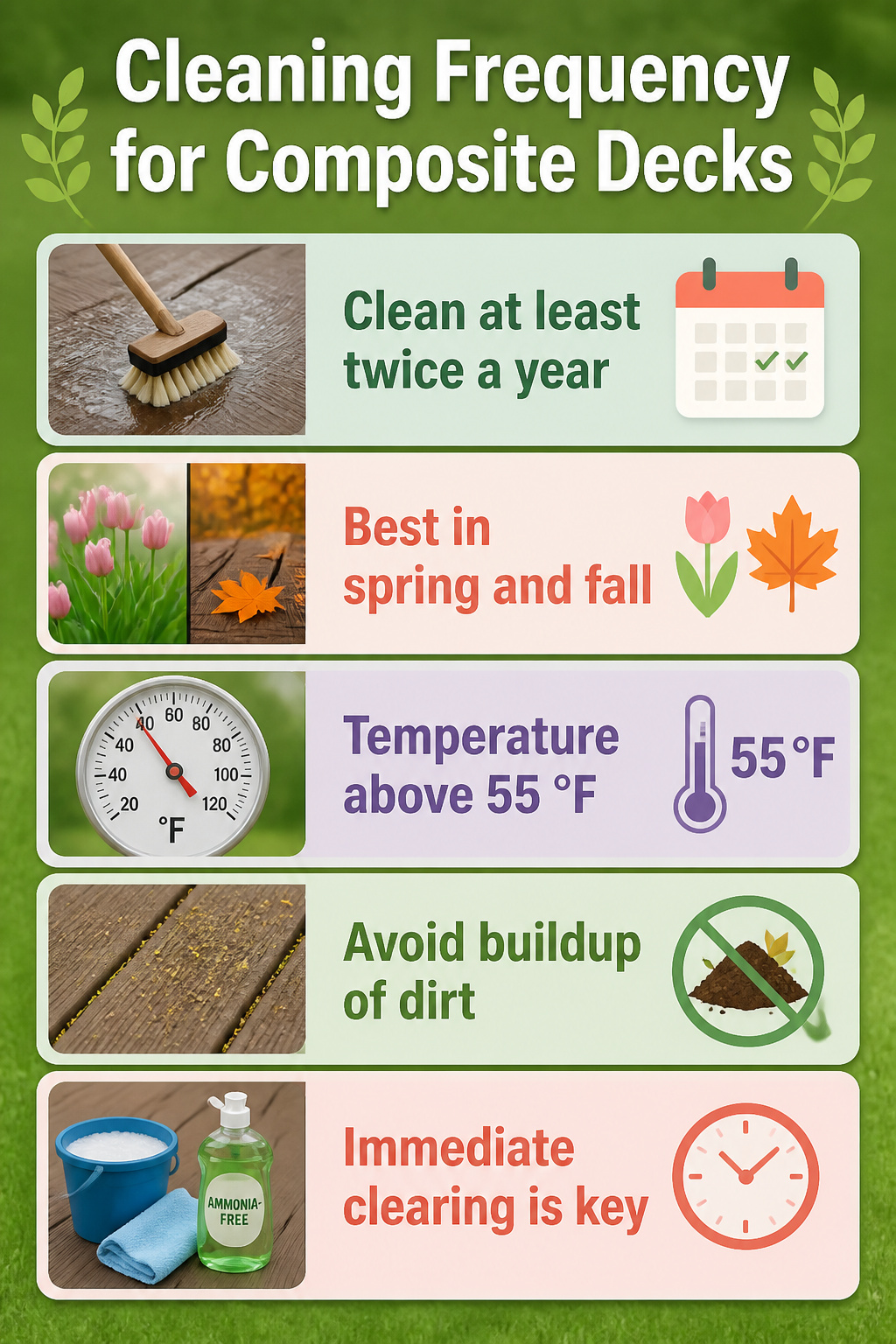
Clean composite decks at least twice a year, usually spring and fall, and the timing matters for more than just habit. Temperatures need to sit above 55 °F for the cleaner to work the way it should, so that seasonal window lines up with when most of us are already outside looking at what winter left behind.
The real risk in waiting longer is what happens to the surface between cleanings. Spills, pollen, and the grime that tracks in from the yard do not stay loose; they settle into the textured grain that makes composite decking slip-resistant in the first place. Once that happens, you are past a bucket-and-brush afternoon and into scrubbing that takes real effort, or worse, reaching for chemicals strong enough that you ought to call the manufacturer first to ask if they will void your warranty. Twice a year is the frequency that keeps the work light and the surface intact. Spot-cleaning when something happens, a quick pass with hot water and a drop of ammonia-free dish soap, fills the gap between those two deeper sessions without adding much time at all.
Stain Types and What They Need
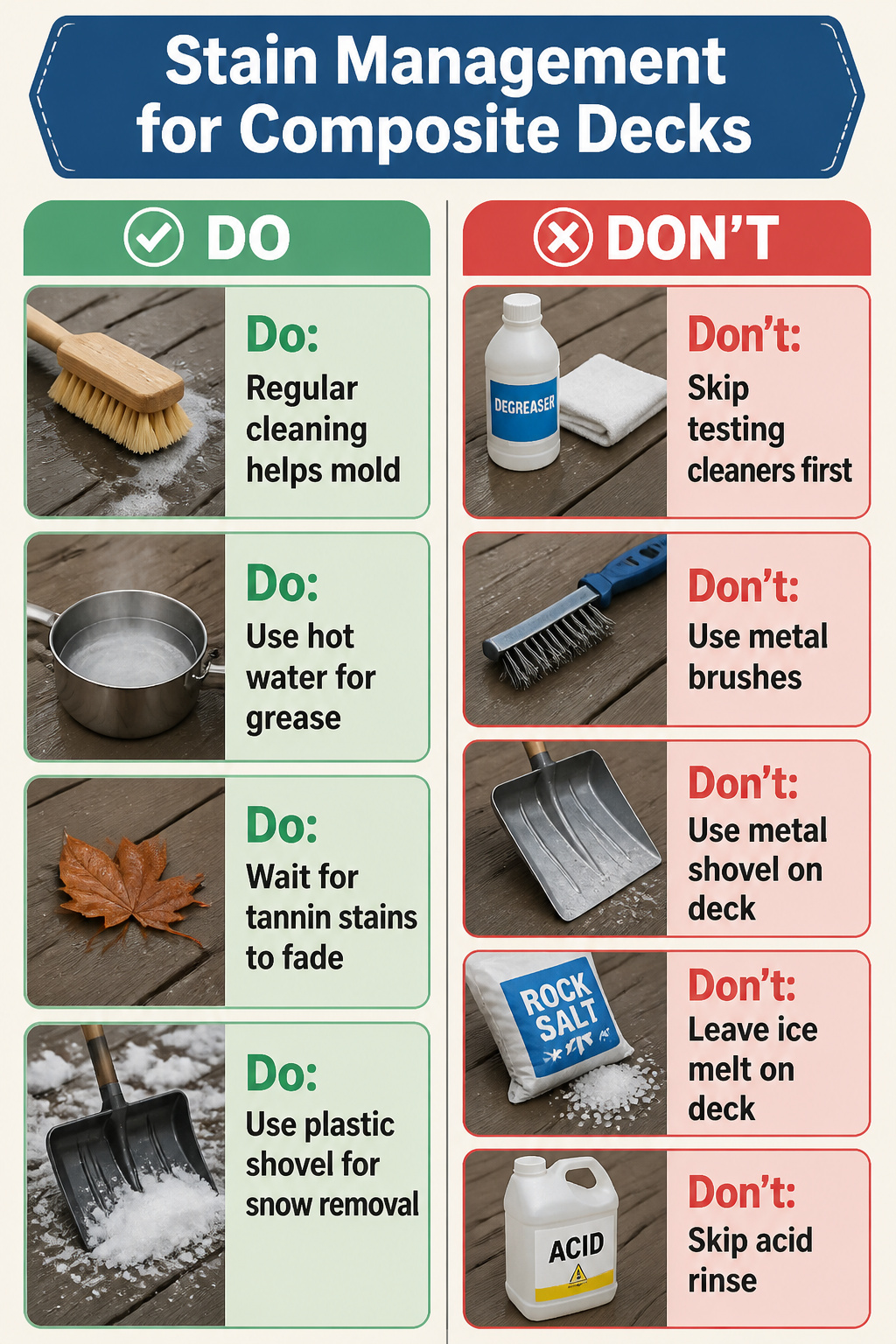
Mold and mildew are the stains composite deck owners see most often, and the ones every set of guidelines treats with the most care. The surface biofilm that holds them feeds on pollen and dirt left sitting too long, which is why the same soft-bristle brush and warm soapy water that clears ordinary grime also interrupts the cycle before it starts. Twice-a-year cleaning is the interval that keeps it from taking hold, not once the spots are already visible.
Grease sits at the other end of the spectrum. The protocol is immediate hot water, then a degreasing cleaner if anything remains, with the open admission that some products can pull colorant from the board. Testing in a hidden corner first is not caution theater; it is the step I would skip and regret.
Tannin stains from wet leaves need patience or chemistry. Twelve weeks of normal weathering will fade them naturally, or oxalic or phosphoric acid accelerates the process. The same acids handle rust and ground-in grime, left to sit ten to fifteen minutes before rinsing. What the sources do not promise is a dedicated rust-specific protocol, and I will not invent one: the acid treatment is what exists, full stop.
Ice and snow melt with calcium chloride or rock salt, rinsed off promptly, and a plastic shovel rather than metal that scratches. The manufacturer warnings on that point are explicit enough that "exercise caution" reads as understatement.
Tools That Matter
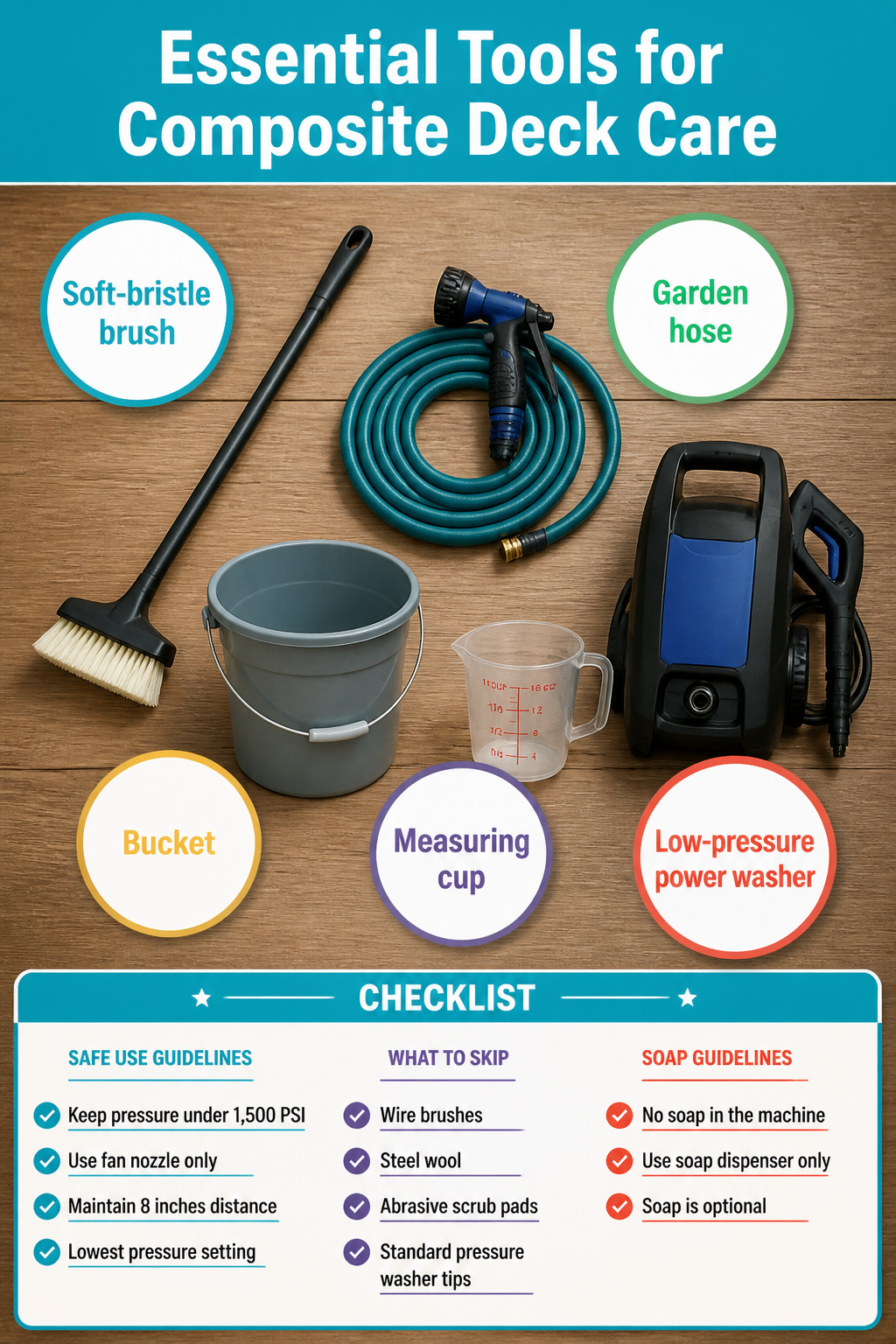
A soft-bristle brush and a garden hose handle most composite deck cleaning without drama. The brush should have a long handle so you are not on your knees, and the bristles need to be soft enough that they will not scratch the cap layer.
Here is what stays and what goes:
- Keep pressure under 1,500 PSI if you use a power washer, and only with a fan nozzle. Trex says 1,500 PSI is perfectly adequate for routine cleaning; TimberTech draws the line at the same number and warns against using soap in the machine at all. The fan tip spreads the force so it does not etch the softer composite surface.
- Skip wire brushes, steel wool, and abrasive scrub pads entirely. They scratch the surface and create pockets where dirt and algae collect more easily.
- Skip standard pressure washer tips too. Narrow nozzles concentrate force past what the decking can take, and that risks irreparable damage plus a voided warranty.
- Optional only: a power washer with a soap dispenser. Even then, the lowest pressure setting and a distance of at least eight inches from the surface keeps you in safe territory.
Why Manufacturer Guidelines Count
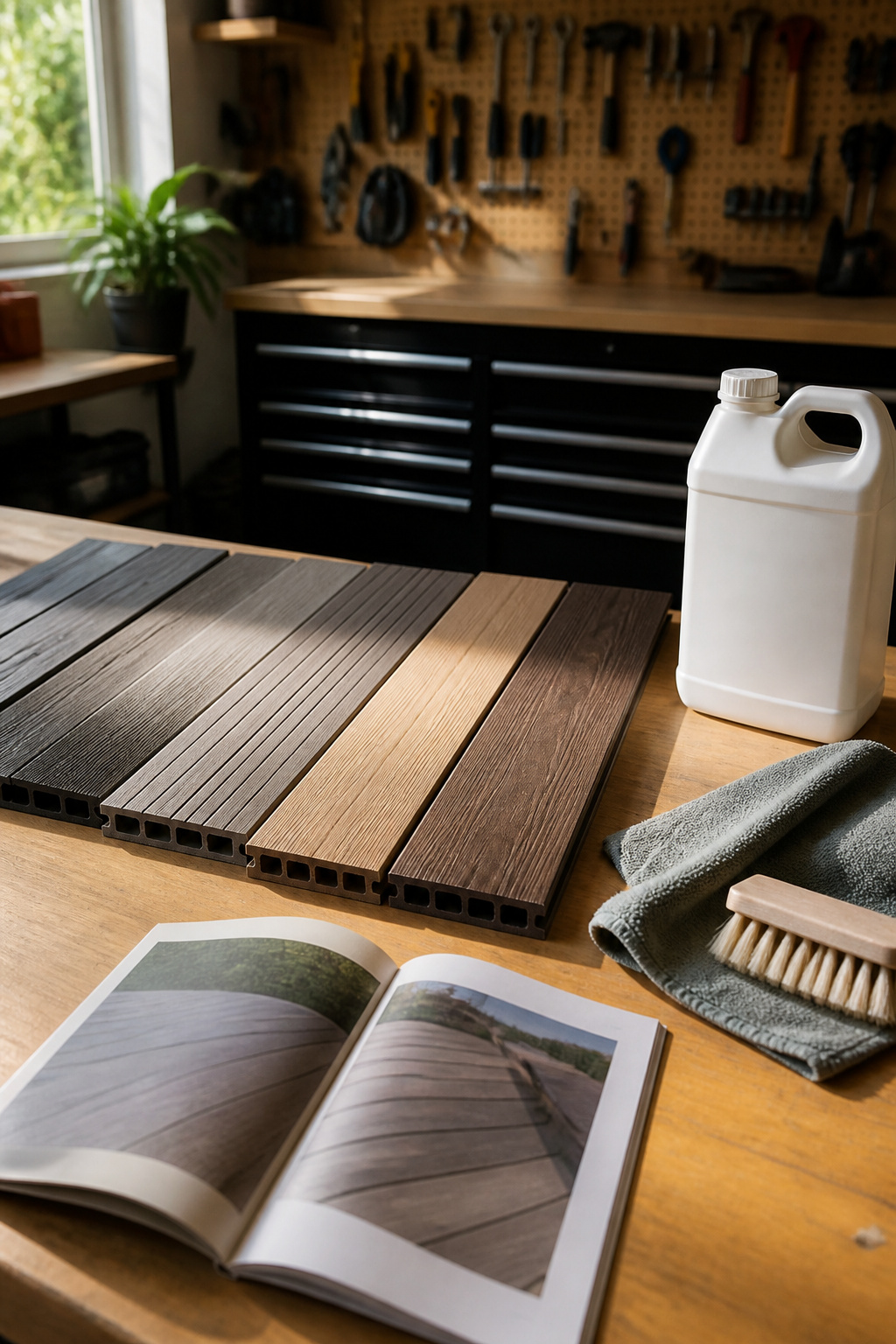
Composite decking is not one uniform material. Some boards carry a protective polymer cap; older or uncapped products stay more porous and stain-prone. Manufacturers use different formulas, colors, and surface textures, which means the label on the deck board and the cleaner both matter. Ignoring either label can void your warranty and leave streaking or uneven color.
I learned that the hard way on a TimberTech deck. The care sheet specified their DeckCleaner product for spot work, and I set it aside in favor of a generic bottle from the garage. The streaking showed up once the boards dried, and the finish never settled back to even. Warm soapy water would have been safer than what I grabbed.
Solvents, high-concentration chlorine, and abrasive agents can deteriorate composite surfaces or compromise structural integrity over time. A cleaner that works on raw wood is not automatically safe here. Check the manufacturer’s care instructions first, particularly if the deck is still under warranty, and contact their service team for anything the guidelines do not cover rather than experimenting with unapproved products.
Frequently Asked Questions
How often should I clean my composite deck?
Clean composite decks at least twice a year, usually spring and fall, when temperatures sit above 55 °F so the composite deck cleaner can work properly. Waiting longer lets grime settle into the textured surface, turning a quick afternoon job into hard scrubbing or risky chemical use. Spot-clean spills between deep cleanings with hot water and a drop of ammonia-free dish soap.
Can I use bleach to clean my composite deck?
No. Bleach is not recommended for composite decking, and the article warns against solvents, high-concentration chlorine, and abrasive agents that can deteriorate composite surfaces or compromise structural integrity over time. Manufacturer guidelines should be checked first, particularly for capped decking still under warranty.
What is the best cleaner for composite decking?
A manufacturer-recommended composite deck cleaner is the safest choice, especially for newer capped decking where warranty protection matters. TimberTech DeckCleaner covers 1,000 square feet and is formulated specifically for composite boards. Simple Green Oxy Solve is an eco-friendly alternative that dilutes at 1:20, while Corte-Clean targets mold and mildew specifically.
Can I power wash my composite deck?
Yes, but only for rinsing, not for doing the actual cleaning. Keep pressure below 1,500 PSI with a fan tip nozzle, and maintain distance from the surface while running it. Trex and TimberTech both draw the line at 1,500 PSI, and TimberTech warns against putting soap in the machine at all. High pressure scars boards, raises surface texture, and forces water where it does not belong.